Introduction & History

 A Oriental rug is a heavy pile or flat woven non pile textile made from silk, cotton, jute, wool, and/or animal hair made in Oriental or Asian countries. This region of the world is called “The Rug Belt”. The Rug Belt spans across Morocco, North Africa, the Middle East, Central Asia, and Northern India; including China, Tibet, Turkey, Pakistan, and Russia. 

Early Evidence of Rug Making

Due to the perishable nature of textiles, the exact origins of woven rugs are not known. There is a large set of archeological evidence spread across the world that shows the use of woven floor materials. The evidence points to felt or flat woven rugs dating back to some of our oldest forms of communication. The earliest written recording relating to rugs dates back to 2nd millennium BC. Archeologists have discovered a clay cuneiform tablet directly referring to carpet weaving taking place in the Mari Kingdom (Modern Day: Syria).

The Oldest Rug – The Pazyryk Carpet
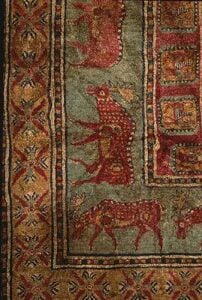
The oldest complete rug, the Pazyryk Carpet, dates back to the 5th century. It is believed that this red rug was originally created in ancient Armenia, though a second school of thought is that the textile originated from Persia due to the symbolic pattern similarity to Persian sculptures in Persepolis from the same time period.


The intricately woven motifs suggest that carpet weaving dates back as early as the end of the 3rd Century. This incredible artifact was found in a large block of ice in the Pazyryk Valley of Siberia. The 2500 hundred year old textile was discovered in 1949 by Russian archaeologist Sergei Rudenko.

The historical artifact was discovered inside the burial tomb of a Scythian prince. In brilliant detail one can still clearly see the borders of elk, deer, horses, and warriors. The Scythian empire stretched from Eastern Europe to Western Asia. The people of this region were known as skilled horsemen and avid hunters. Their way of life is depicted in great detail. The tapestry includes 28 horsemen – 7 on each side. This number is remarkable because it corresponds to the number of leaders holding thrones from Xerxes to Perspolis. In addition there are 6 Elk, with clearly labeled anatomy mapped almost to medical level precision.

In 1991, FAU researchers including Professor Dr. Karl Meblinger from the Institute of Physiology and Pathophysiology, Professor Dr. Andreas Spath and Dr. Rainer Fink from the Chair of Physical Chemistry II concluded that artisans used a pungent red dye composed of Porphyrophora hamelii or Armenian Cochineal, an insect found in areas of Armenia and Turkey. After dying, the wool would go through a fermentation process to strengthen the vibrant hue. Fermentation was achieved by spreading the wool in a field for weeks during sunny seasons and/or by utilizing the wool as bedding for sheep prior to rinsing. This fermented dyed wool textile stands as a testament to the highly skilled artisan techniques in practice during the Iron Ages.

The basic design layout, a large pattern with an intricate border and secondary borders, is on par with the current traditional patterns associated with Oriental rugs.

Preservation of the Pazyryk Carpet

Incredibly, the careless mistreatment by tomb raiders shortly after the prince’s burial are thought to have directly contributed to the rug’s preservation. After raiding the burial site, the thieves left the rug in place without covering the hole they dug to enter the grave. This open exposure led to the rug being frozen in place in a thick sheet of ice due to the harsh Siberian environment. The well preserved textile can be viewed in person in St. Petersburg, Russia at the Hermitage Museum.

Other Ancient Rug Discoveries

Victoria and Albert Museum,in London currently houses carpet relics discovered in Turpan, East Turkestan, China dating back to the 4th and 5th century B.C. Fragments found in Dura-Europos, Syria, and from the At-Tar caves in Iraq are thought to date back as early as the 1st century. Al-Sabah Collection in the Dar al-Athar al-Islamyya, Kuwait houses rug fragments from Afghanistan that feature mythical creatures like unicorns, winged horses, and stags and more. Writings by Marco Polo in the 13th and 14th centuries discuss a bustling carpet trade. Carpet fragments discovered in Konya and Beyşehir, Turkey and Fostat, Egypt from that time period suggest that the carpets were 20 feet long! It is unknown exactly how these carpets were produced. It is thought that there must have been factories or commercial sized looms to support weaving materials of this size. The fragments of carpet show different designs, mostly geometric shapes in blue, red, green with white, brown, yellow accents.

Development of Rug Making Techniques

The first pile woven carpet seems to have been originally developed by settled people who were knowledgeable of the previous extra weft wrapping styles. Nomadic migration from Central Asia may have contributed to the distribution of rug making techniques throughout the area now known as the “Rug Belt”. Under the rise of Islam, the knot piled technique spread; soon the term “Islamic Carpet” followed the carpet trade of the nomadic people.

The discoveries and techniques explored in this content shed light on the long and rich history of rug making. From the early evidence of rug making to the intricate motifs of the Pazyryk Carpet and the development of rug making techniques, the story of rugs is one of skilled artisans, cultural exchange, and the enduring beauty of textiles.

Types of Oriental Rugs


What is the Difference Between an Oriental Rug and a Persian Rug?

Oriental rug is a larger umbrella term used to describe any rug made in an Oriental or Asian country. This includes India, China, Iran, Pakistan, Afghanistan, Turkey, and more. Persian rugs are made in modern-day Iran and Turkish rugs in Turkey. Each region has its own stylistic differences.

Oriental rugs are handwoven using a loom and a series of hand-tied symmetrical knots, sometimes referred to as Ghiordes. It is this painstaking handcrafted attention to detail poured into each rug that makes them valuable. While each region has its own cultural additions, a key element of oriental rug design involves the use of geometric shapes, landscapes, florals, and animals often in contrasting colors and textures to create a sense of depth and space. Oriental rug design usually falls into one of two categories:

  • Curvilinear Design – intricate design often floral
  • Rectilinear Design – geometric with strong use of angles

Oriental rug patterns are divided into two sections: the field and border. The field refers to the center section of the rug where the central figure or design is featured. The field may be a solid color or a complicated pattern. Types of Fields include:

  • An Open Field – A solid color centered among multiple borders. This is a common design feature of Persian rugs including Tabriz, Kashan, Sarouk, and Hamadan and Kerman, Caucasian Talish and Kazak rugs, Nepalese, Sultanabad, and Tibetan.
  • The Medallion – This can be a large central figure against a solid background or a repetitious pattern.
  • Repeating Pattern – includes multiple rows of the same pattern in succession, sometimes the pattern involves a medallion. Examples include the Mina Khani, Gul, herati, and boteh.
  • The Prayer – The field may include urns or stars with an arch or a Mihrab (Mehrab) at the top. The region of the rug’s creation will often determine the use of floral or geometric patterning.
  • The Panel – a grid-like structure of repetitive geometric patterns such as squares, diamond, rectangles…typically these repeating patterns include nature motifs like flowers, trees, stars…
  • Pictorial – In the late 1700’s, pictures, landscapes, daily life, historic events, and art scenes were featured designs
  • All Over – This usually features non-repetitive unstructured use of natural motifs such as vines, flowers, trees…

The borders surrounding the field usually contain intricate designs and repeating patterns such as stars, roses, geometric patterns; in rare cases, they may include poetry, lyrics, prayers, or inscriptions. Depending on the rug, there may be upwards of 10 borders surrounding a field.

Other key Elements may include:

  • Guard Borders – This is an additional narrow border that “guards” the main border
  • Spandrels – This is a pattern at the four corners of the field, this pattern may be solid or patterned.
  • Pendants – These are intricate details added to the top and/or bottom of the medallions.

Persian Rugs

Persian Rugs or Iranian Carpets are a subset of the larger umbrella category of oriental rugs. The handwoven technique has been passed down for hundreds of years through skilled apprenticeships. Techniques and patterning are often region-specific, a direct reflection of years of passed down traditions. Trained experts are usually able to identify the region of creation due to the pattern, markings, colors, and patterned techniques.

Persian rugs involve intricate designs; two most common Persian rug designs are the medallion and the all-over pattern. Persian rugs have been highly prized possessions of great value detailed even in the writings of the Ancient Greek Philosophers. Persian carpets dating back to the 16th century consisting of bold color and intricate design are cherished relics in a number of museums and private collections. Common Persian rug symbolism includes a variety of geometric shapes, florals, and other natural elements like stars and animals. Stories, customs, cultures, and even prayers can be seen in the detailed elements.

Examples of Persian rug symbols include:

  • Stars represent spirituality.
  • Amulets offer protection from evil.
  • Dogs serve as a trusting symbol of defensive protection.
  • Parrots represent an escape from danger into protection.
  • Peacocks symbolize immortality.
  • Hyacinth is a reminder of regenerative power.
  • Lily demonstrates spiritual purity.
  • Iris is a symbol of religious liberty.

Turkish Rugs

Turkish rugs have a rich history with recorded history dating back to the Seljuk Empire Turks weaving brightly hued carpets in Anatolia during the 13th century. A true Turkish rug is woven in the region of the former Ottoman Empire or what is now Turkey using the long steeped traditions of the area. It is important to note that a Turkish rug is only authentic when created in the region; any rug utilizing the traditional patterns, symbology, or techniques outside of Turkey are considered to be inauthentic and so not hold the same level of value.

As with Persian rugs, Turkish rug design is influenced by the region or city where it is created. Common examples of Turkish rug styles include:

  • Kilim – flat, hand-woven non-pile reversible rug
  • Sumak – flat hand-woven no-pile non-reversible rug with a backing of threads 2-4 centimeters long for added cushion
  • Cicim or Jijim – a type of Sumak made with varied colored strips of fabric woven together on a regular piece of fabric woven together on a narrow loom in the area of Anatolia.

The Kilim, Sumak, and Cicim have their own regional styles. Examples of these regional style differences in Turkish rugs include:

  • Bergama rugs – are typically made with symmetrical knots of bright red wool with bold medallion patterning.
  • Tulu rugs – these extra soft and silky rugs are typically made from curls of angora goats, with a long pile woven into large knots.
  • Konya – are especially collectible, notable historical mention by Marco Polo refers to the Konya as “the most beautiful in the world”. These bold red carpets infuse strong tribal motifs with hexagonal shapes and are made from some of the finest wool worldwide.
  • Oushak or Ushak – Made from cotton, wool, silk, and occasionally metallic threads with a cotton foundation and a wool pile typically crafted in warm earth tones of red, golden yellow, soft blue, and ivory in complicated patterns.
  • Hereke – Made from the finest silk, using cotton, camel hair, wool, and occasionally metallic threads. These fine carpets are extra-large made for palace-sized spaces.


Indian Pakistani Rugs:

Indian and Pakistani rugs date back to the 16th century under the reign of the Mughal Empire. It is thought that these practices were originally learned from Presian culture since the techniques favor each other. The rugs from this time period show large flowers with broad leaves on bright pungent red fields. The floral designs of these floor coverings are often based more on the natural floral pattern versus an ornamental interpretation. The modern rugs produced in these areas are now predominantly influenced by designs and patterns from other cultures and are now more of a practical use versus collected mainly for monetary value.

South Africa rug culture began in the 1970s when Greek entrepreneurs hired Pakistani rug makers to teach locals the textile artform in Swaziland. In 1982, the company was moved outside of Queenstown and named Xhosa Carpets. Later it was renamed again to Illinge Crafts by Transkei Development Corporation. The rugs, including custom

Buyer’s Guide for Oriental Rugs:

Oriental rugs are highly prized valuables; known for their fine quality and attention to detail these tapestries hold the test of time and can be quality antiquities shared for generations. As with any investment, it is imperative to have a firm grasp on the finer details in order to spot a fake. Unsure what to look for when buying a Oriental rug? Here are our rug buying tips, including how to know if an Oriental rug is authentic:

  • Always purchase from a reputable carpet company. Since 1999, Jaffe Rug Gallery has been Jacksonville’s leading fine rug expert.
  • Oriental rug price ranges vary. Consider the space and the use to help determine your budget. Remember, heirloom pieces come with steeper prices.
  • Beware pressured sales, this can be a red flag for in-authenticity.
  • Allow room in your budget for regular cleaning every 3 – 4 years to preserve life.
  • Select a room with relatively low traffic patterns with little to no possibility of water exposure.
  • Be cautious of inexpensive pricing, true oriental rugs cost more than standard carpets; if it seems like an impossible deal – it’s probably a fake.
  • Hire a rug expert when considering purchasing a vintage or heirloom piece, especially when purchasing from an individual.
  • Find qualified sales staff and ask questions. A skilled carpet salesperson will be educated on the details of the rug and able to easily communicate its finer features and points of value.
  • Know the difference between a Professional Oriental Rug and a Village Oriental Rug. Professional Oriental Rug designs are usually selected based on popularity, made from cotton or silk, and have more knots than the average Village produced oriental rug. Village Oriental rugs are often crafted in homes under the skillful supervision of a master craftsman. The weavers work from carefully detailed pre-planned designs. Experienced workers often have these complicated patterns memorized allowing them more freedom of artistic interpretation. With this creative process, it is important that the master weaver has excellent quality control skills employed. Obviously, the Village Oriental Rugs are prized at a much higher cost/value. At Jaffe Rug Gallery, we specialize in hand knotted Village Oriental Rugs. Our artisans spend months hand tying each individual knot to its foundation.
  • The underside of the rug should have all of the hallmarks of rows of knotted threads. Any carpet with a backing covering this feature should be eyed suspiciously for authenticity.
  • The backs of an authentic hand knotted Oriental rug are slightly irregular and uneven; machine-sewed rugs stitching is tight, uniform, and even.
  • A plastic backing on the rug warns the pile is made from synthetic fibers.
  • Authentic rugs usually have a strong visible pattern on the underside of the rug.
  • Artificial silk is a trademark sign of a knock-off rug. Artificial silk is a non-durable textile that loses its shine quickly. How to tell if a rug is made from artificial silk? A telltale sign is the number of knots per square inch. The average artificial silk rug has 150-250 knots per square inch instead of the traditional 250-500 knots per square inch.
  • Fringe – Authentic silk rugs have silk tassels, but artificial silk rugs often have cotton tassels. If the fringe has been glued it is a fake.
  • Rub your clean palm quickly with light pressure against the pile, if the carpet warms it is a sign that the rug may be actual silk.
  • Hand Tufted is proof of a counterfeit. Hand Tufted is a technique that involves using a tufting gun to punch the threading through a stencil onto canvas. Authentic Oriental rugs are hand knotted, this

How Do You Maintain an Oriental Rug?
10 Tips for Oriental Rug Care

1. Avoid Sunlight – Living in the Sunshine state, escaping the sun all together isn’t practical, but preventing your Oriental rug from directly absorbing UV light will greatly preserve the life of your carpet. Regular direct sunlight exposure bleaches color and causes carpet fibers to become brittle. To help combat this problem, we suggest placement away from large glass windows and doors when possible, as well as the use of window coverings such as blinds, shades, sheers, drapery, or tinted windows.

2. Vacuum Weekly – The 3 step process:

1) Vacuuming the top of your rug weekly will help remove dirt, dust, and debris reducing traffic patterns. When vacuuming an Oriental carpet, it is important to set the vacuum to a high pile setting. An improper setting can cause damage to the fibers by applying too much pressure and scraping. Working slowly, begin vacuuming at the corner in the direction of the fibers, pulling back and then pushing forward 2-3 ft sections at a time creating a triangular pattern. Be careful not to suck up the fringe – later, you will want to use the furniture wand feature of your vacuum to carefully clean the fringe. Repeat this process twice.

2) Did you know you should also vacuum the back of your Oriental rug? Every 6-8 weeks, we advise vacuuming the back of your oriental rug prior to vacuuming the top. With your vacuum on the highest pile carpet pile setting, slowly vacuum the underside of your rug to remove any dirt from the underside of your rug, while simultaneously, loosening the dirt, debris, and dust from the top layer.

3) Concerned about the beater bar setting on your vacuum still being too low even on the highest setting? Worried about your delicate hand hooked or braided rugs? Carefully sweep, shake, or beat the back to loosen dirt, debris, and dust. When sweeping, choose a soft straw bristle broom, starting at the corner and working in 2-3 ft segments, brushing the same direction as the carpet fiber.

3. Rotation – Just like a mattress, regularly rotating your rug helps distribute wear patterns.

4. Use a Rug Pad – We recommend using a natural fiber 1/4in carpet pad under your rug. There are multiple benefits to carpet pads including:

• Safety – Secure your rug in place to prevent slips, tips and falls.
• Preserves Fibers – Padding provides fiber support preventing damage by reducing impact pressure.
• Airflow – Elevating the rug off the floor increases airflow preventing a build up of debris, mildew, and mold.
• Wrinkle Prevention – Carpet pads prevent wrinkles or creases in your carpet

5. Furniture Placement – Choose your furniture placement carefully. Heavy furniture such as seating, beds, and dressers can damage the carpet fibers causing dents. We recommend placing your rugs in front of your heavier pieces, reserving direct placement for lamps, coffee, and end tables. In addition, furniture coasters are an excellent option for additional protection from furniture legs.

6. Let it Breathe – Carpets, like people, need to get outside once in a while. We advise hanging your rug outside twice a year on a warm, dry, sunny day to prevent mold and mildew. Note: Always check for low humidity levels prior to hanging. Homes can be humid places, allowing your rug time to hang in a dry environment for a few hours can do wonders in preventing moisture problems.

7. Fringe Care – Fringe can easily become tangled. Though tempting, do not attempt to comb your fringe, you can inadvertently damage the delicate strands. Instead, we recommend one of two methods. Either gently shake out the fringe or gently grasping the fringe edge and walking the carpet back over itself allowing gravity to assist in de-tangling.

8. Spot Cleaning – Clean any spills immediately.

For liquid spills: Using a white absorbent rag, lightly blot the liquid. Avoid using a colored cloth, to prevent accidentally transferring dye from the rag to your carpet. For spot removal mix ¼ cup of white vinegar with warm water, lightly dip rag, blotting the carpet spill. Allow to sit 3-4 minutes before blotting dry.

For food or debris spills: Using a spoon gently remove any particles. It is critical not to rub or grind debris in further while attempting to remove it. Using a white absorbent rag, lightly blot the liquid. Avoid using a colored cloth, to prevent accidentally transferring dye from the rag to your carpet. For spot removal mix ¼ cup of white vinegar with warm water, lightly dip rag, blotting the carpet spill. Allow to sit 3-4 minutes before blotting dry. Follow up with vacuuming.

9. Pet Patrol – Monitoring pet friends, especially puppies and kittens, will help ensure the life of your rug. While establishing proper potty places for young pets, it may be in your best interest to temporarily store your rug. For proper storage directions see step 10. As with most things, prevention is the best course of action when possible. Keeping your pets regularly walked, entertained, and fed improves the odds of accident prevention. If your pet does have a potty related accident, follow step 8. At Jaffe Rug Gallery, our trained experts are highly skilled at effectively removing pet stains. We even provide furniture moving, rug pick up, and delivery. Call our office today for immediate service.

10. Proper Storage – If you need to store your rug, roll your carpet against the grain. Secure it with a rope or belt. Cover with airtight polythene plastic, before tying the end add a few moisture absorber packets to prevent mildew or odor. Store in a cool dry place, away from direct sunlight or possible water exposure.

FAQ’s


Oriental rugs range in price. The average Oriental rug ranges hundreds to thousands of dollars depending on materials, size, quality, intricacy, and region of origin. 

Authentic Oriental rugs are made from only the finest natural fibers. Each knot is hand tied under the supervision of a master weaver. 

The most expensive rug ever sold was the Clark Sickle-Leaf Vine Carpet, a 17th century Kerman rug sold for 33.7 Million at an auction held by Sotheby’s.

The finest Oriental rugs are made with wool, silk, or other only natural materials.


Depending on quality, use, and level of care, an Oriental rug can last anywhere from 20 years to centuries. 

  1. What is the place of origin for the Oriental rug? Different regions offer different styles, techniques, and craftsmanship.
  2. What is the condition of the rug? Are you buying a new, used, vintage, semi-antique or antique Oriental rug? Well preserved rugs fetch higher prices. 
  3. What fibers were used to make the Oriental rug? The finer quality materials including silks, metallic thread, and angora are examples of materials with high dollar value. 
  4. What is the construction of the Oriental rug? Is it a single or a double knot process? For a more extensive list of construction methods to look for, view our Buyer Guide for Oriental Rugs. 
  • A telltale sign is the number of knots per square inch. The average artificial silk rug has 150-250 knots per square inch instead of the traditional 250-500 knots per square inch. 
  • Fringe – Authentic silk rugs have silk tassels, but artificial silk rugs often have cotton tassels. If the fringe has been glued it is a fake.
  • Rub your clean palm quickly with light pressure against the pile, if the carpet warms it is a sign that the rug may be actual silk.


We recommend vacuuming the topside of your oriental rug weekly; taking care to vacuum the underside every 6 to 8 weeks. 


Yes! Every 6-8 weeks, we advise vacuuming the back of your oriental rug prior to vacuuming the top. With your vacuum on the highest pile carpet pile setting, slowly vacuum the underside of your rug to remove any dirt from the underside of your rug, while simultaneously, loosening the dirt, debris, and dust from the top layer.

It is ok to place light furniture, such as lamps, side and coffee tables on Oriental rugs. We do not recommend placing seating that will be used or heavy furniture on your rugs, especially long term to prevent damage to the fibers including permanent dents.

If you need to store your rug, roll your carpet against the grain. Secure it with a rope or belt. Cover with airtight polythene plastic, before tying the end add a few moisture absorber packets to prevent mildew or odor. Store in a cool dry place, away from direct sunlight or possible water exposure.

A rug is considered vintage when from 20-50 years old. Semi Antique rugs are 50-80 years old. Rugs older than 80 years are categorized as antiques.

Yes! We highly recommend using a high quality ¼ in thick pad made from natural materials. 

The top 5 reasons you should use a pad under your Oriental rug:

  1. It preserves the life of your rug – the pad acts as a buffer between the impact zone and the floor, preventing the pile from extra pressurized wear. 
  2. It holds your rug in place preventing unnecessary slips, trips, or falls. 
  3. The extra support of the pad adds a luxurious element underfoot. 
  4. The pad adds an extra layer of protection to hard floors. 
  5. Increased circulation of airflow to the carpet fibers preventing mold and mildew. 

We recommend a pad ¼ inch thick.

We recommend having your rugs cleaned every 3-4 years depending on your use. 

No! This will destroy your rug. Call our experts at Jaffe Rug Gallery to schedule professional cleaning every 3-4 years or as needed.


No! The Rug Doctor uses a water based cleaning treatment that will destroy a Oriental rug.

We recommend a ¼ cup of white vinegar mixed with warm water applied with a clean white rag. Allow to rest a couple minutes before blotting dry.

[simple-author-box]